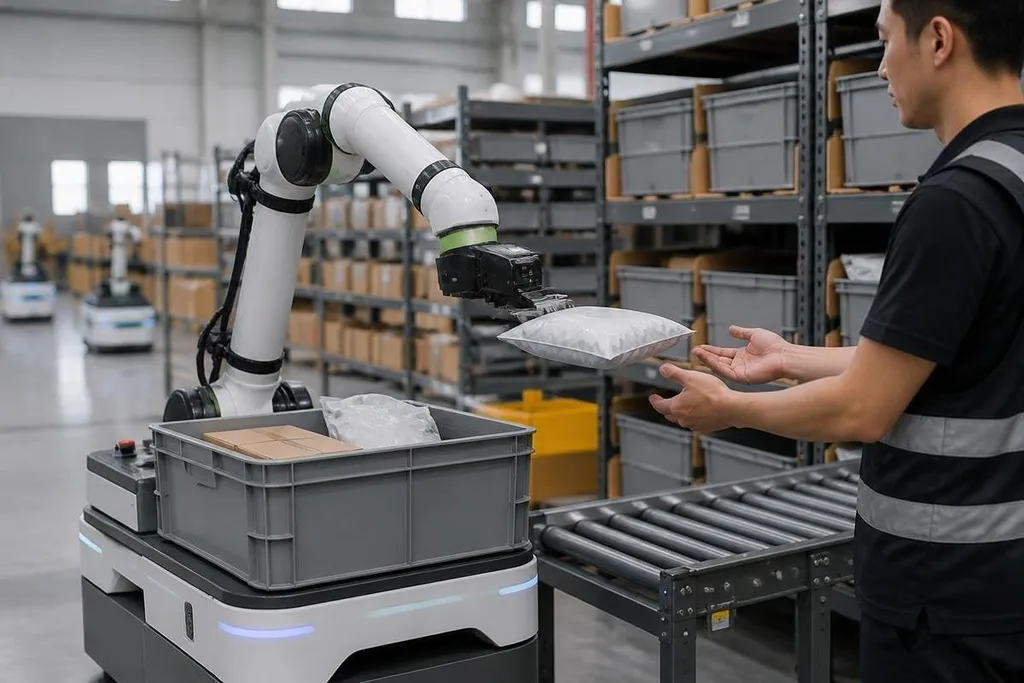
An e-commerce robot can pick a parcel from a tote and still fail the job. The hard part starts when that parcel reaches a person, a conveyor, a shelf, or another robot. For teams building warehouse automation, the useful question is how each machine handles those handoffs under changing orders and layouts.
- Picking: cameras and grippers must identify items with different shapes and surfaces.
- Movement: mobile robots need safe paths around people, shelves, and other machines.
- Handoffs: the parcel must arrive at the right station with its status recorded.
Picking is where the physical work begins
E-commerce orders rarely contain objects made for robots. A tote can hold a soft bag, a boxed product, and a reflective package in the same trip. Each item asks for a different grip, force, and approach angle.
A robot arm uses cameras to locate an item, then plans a path for its end effector, the tool that touches the product. Suction can work on flat packaging. A two-finger gripper may handle a rigid box more safely. Soft goods can fold, slide, or hide their edges.
That makes picking a perception problem as much as a movement problem. It has to identify the item, estimate its position, choose a grip, and check whether the object moved as expected. A failed pick creates a second task for a person, so the machine's recovery process matters as much as its first attempt.
Movement has to fit the warehouse
Autonomous mobile robots, or AMRs, move shelves, totes, or parcels through a facility. Many use LiDAR, cameras, and wheel encoders to build a map and estimate their position. The details matter because a route through an empty test area says little about a busy packing floor.
An AMR needs to slow near a person, stop when a pallet blocks its path, and resume work after the route clears. Its software also has to handle temporary changes, such as a cart left in an aisle or a station that has gone offline.
Speed is useful when it keeps the next station supplied. A fast trip followed by a long wait at a conveyor can leave the order process unchanged. That is why warehouse teams should measure the full movement cycle, including waiting, docking, loading, and the time needed to recover from a blocked route.
Cycle time also depends on the handoff after each trip. E-commerce robotics reporting can place those transfers beside the robot's speed, payload, test site, and date, so the next section can ask where a delay starts when people and machines share the work.
Handoffs decide whether a fleet works
A warehouse robot rarely completes an order alone. It may carry a tote to a person, pass a parcel to a conveyor, or place a container at a charging station. Every handoff needs a clear location, a shared status, and a way to confirm that the item arrived.
This is where software connects the physical work to the order system. The warehouse management system sends the task. The robot reports its position and status. A station confirms receipt. If one message arrives late or names the wrong container, the physical process can stop even when the motors and sensors work correctly.
Teams should ask to see recovery steps, not only successful runs. A useful test includes a blocked aisle, a missed grip, a full tote position, and a network loss. The machine should report the fault in plain terms and leave the parcel in a known state.
The race needs better measures
Companies building e-commerce robots often present a single task: a pick, a drive, or a handoff. Buyers need a longer view.
The useful measure is the completed order cycle, starting when the item is located and ending when placement is confirmed, with human help and recovery time included. That measure also makes systems easier to compare.
A robotic arm with a careful grip may suit a packing station. An AMR may suit tote movement. A fixed conveyor may still be the better choice for a repeated route. The right system depends on the work already happening in the building.
I’d judge a robot by the work it completes after the first error, not by its cleanest demo.
A buyer's check before a pilot
Use these questions before putting a machine into live order work:
- Name the task: Does it pick, move, sort, pack, or pass items to another station?
- Check the item range: Have the team tested soft packaging, reflective surfaces, small objects, and mixed totes?
- Time the full cycle: Does the result include waiting, docking, charging, and human recovery?
- Test the faults: What happens after a blocked route, missed pick, full station, or lost network link?
- Check the handoff: How does the system confirm the right item reached the right place?
- Price the support: Which parts, software access, training, and site changes are included?
The global contest in e-commerce robotics will be decided inside these ordinary moments. A robot that picks one item cleanly is useful; a system that keeps orders moving after a missed pick, a blocked aisle, and a late handoff is ready for a serious pilot.